3i-Atlas
The Milky Way Visitor
And the glow that changed everything
3i-Atlas
The Milky Way Visitor
And the glow that changed everything
Legend of
Christmas Carl
3-Min Rod Serling-Style Narrated Story
Providence’s
Lost Design Invention
Resurfaces
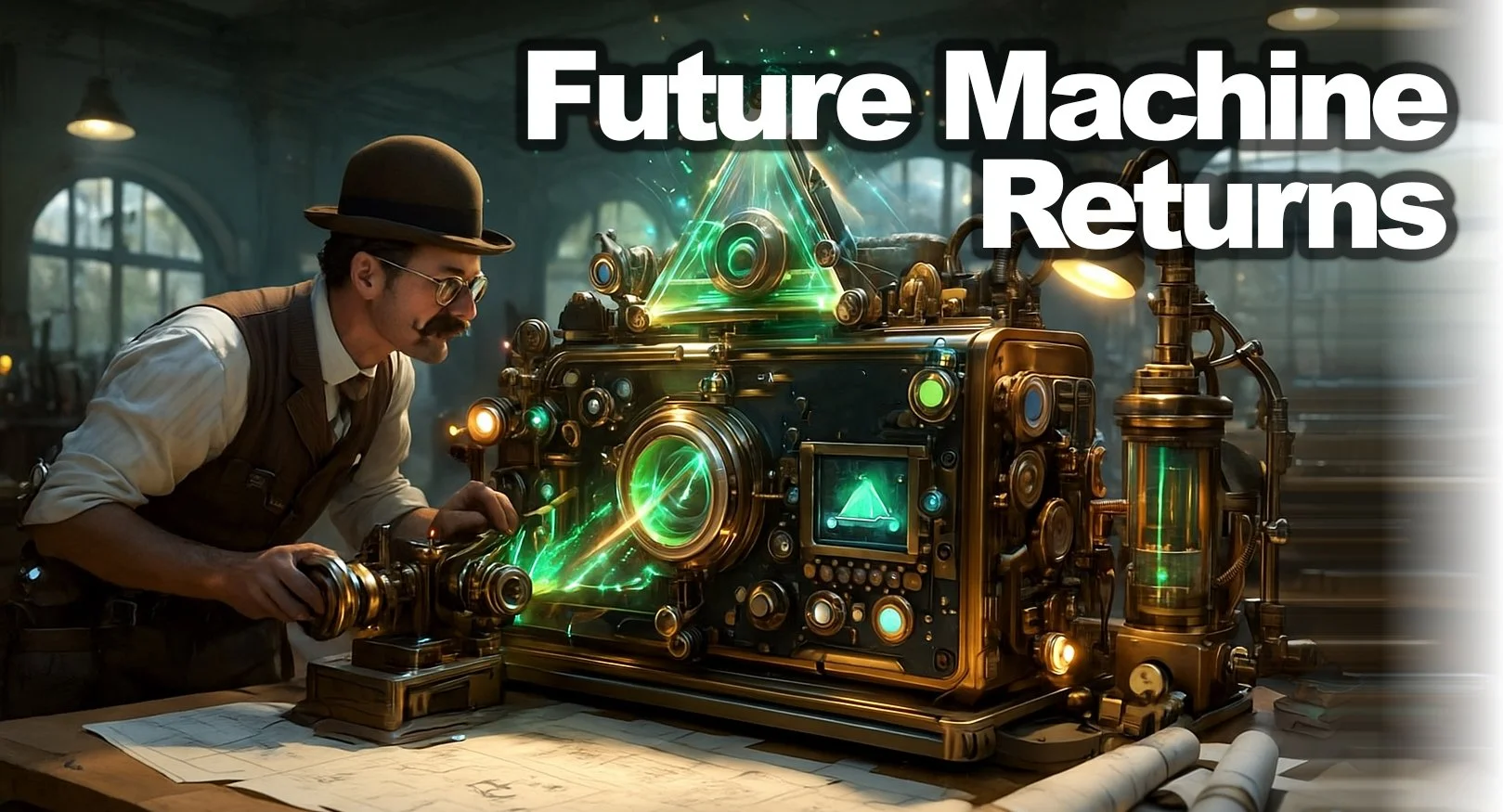
"The Higgins Ghinknobulater"
~ 160 Years Later
By AB Marcus
Providence RI - An 1860s creativity machine from 333 Waterman Street is shaking up today’s design world.
A strange piece of Providence history has returned to the spotlight and it’s causing a stir among designers, futurists, and AI thinkers.
On April 10, 1865,
Dr. Gregory J. Higgins, a reclusive inventor tucked away in Providence's Richmond Square inside the old factory building at 333 Waterman Street, unveiled a prototype device he claimed could “measure and magnify, meticulous, magnificent, magnanimous imagination ideas.”
The machine’s name: The Higgins Ghinknobulater. Pronounced ("Higgins Ghin-Knob-U-Later")
Originally intended as a tool to analyze early creative thought, the device malfunctioned during a full-power test and instead began producing fully formed design storylines, eerily predicting future innovations, designers, and creative breakthroughs that hadn’t yet occurred.
In one surviving notebook, Higgins wrote: “These stories are not predictions they are messages. They point toward the writer who will complete them.
Initials: "AB”
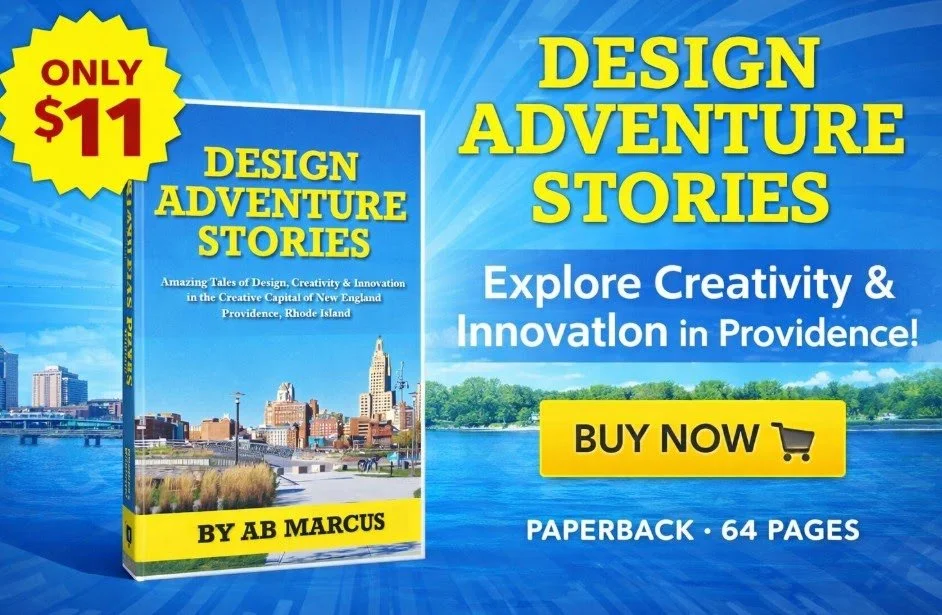
Today, many see a connection to PVD's own AB Marcus, creator of Design Adventure Stories, whose work mirrors the imaginative patterns the machine once produced.
The Higgins Ghinknobulater feels less like a relic and more like a prototype of the world we’re entering now.
And with the latest updated 21st century prototype it is sure to create innovation in a new way.
Providence, the Creative Capital of New England, once again, proves itself a place where creativity, technology, and astounding, ambitious, adaptable myths converge.
Tragically, Dr Higgins was taken too soon when he died in the notorious Richmond Switch, RI train accident of April 19th 1873 - known today as Wood River Junction, RI.
The horrific accident cut short a brilliant mind whose machine was only beginning to reveal its purpose.
After Dr. Higgins’ sudden death, the Ghinknobulater prototype was quietly seized among his estate items, mislabeled in the confusion, and sold at auction in 1874.
The buyer, a British intermediary, shipped it overseas in a sturdy walnut crate stamped:
“Experimental Optic Chrono-Analyzer ~ Handle With Care.”
Arrival in England (1874–1886)
The trail picks up in Kent County, England, where according to a surviving family story, the crate arrived unexpectedly at a small shopkeeper’s residence. No one in the household knew why they had been chosen to receive it, only that the shipping papers referenced “an American scientific curiosity for educational enrichment.”
Inside the home was a young boy with a shattered leg, bedridden for months after a fall on a gravel embankment.
His name was Herbert George the son of the shopkeeper and a ladies’ maid.
To distract him from the pain, his father placed the mysterious device beside the bed, along with new books to keep his mind active. But it was the machine that held the boy’s attention.
The Higgins Ghinknobulater odd even by Victorian standards was packed with concave lenses, shimmering filaments, and ten intricately marked brass knobs.
It hummed faintly at night, the way an idea hums before it arrives.
Sometimes it flickered, as if catching thoughts not yet formed.
Little Herbert George swore that when he drifted between sleep and waking, the Ghinknobulater spilled fragments of worlds that did not yet exist:
Cities of glass and iron.
Creatures evolving beyond the edge of possibility.
Machines that folded time.
Visitors from distant planets.
Invisible forces waiting to be named.
The boy couldn’t explain it.
He simply began writing.
He loved the ideas the Higgins Ghinknobulater created so much that from then on he would sign all of his stories using only his initials:
H.G.
And so was born the Birth of a New Genre
And of course, within two decades, the world was introduced to:
the new science fiction writings of The Time Machine
The War of the Worlds
The Invisible Man
The First Men in the Moon
Stories that felt less like inventions and more like transmissions continuations of patterns Dr. Higgins had begun charting at 333 Waterman Street, Providence, Rhode Island years earlier.
Some now say H.G. Wells didn’t invent science fiction.
They say Providence, Rhode Island exported it.
Then this odd device In 1886, surfaced mysteriously, with no shipping invoice inside a locked cabinet in the Research Reading Room of the University of Edinburgh, Capital of Scotland.
A young medical student, Arthur C. found it.
He was not yet a doctor.
He was not yet a name.
He was a restless 27-year-old medical student who spent more time imagining cases than studying anatomy.
One rainy afternoon, seeking distraction from his coursework, Arthur opened the ornate cabinet. Inside, wrapped in fraying 1860s Providence linen, sat the Higgins Ghinknobulater: brass dials, mirrored arcs, and a small etched plate reading:
H. G. Providence, Rhode Island, 1865
Arthur curious, skeptical, and predisposed to experiments touched one of the machine’s polished “thought mirrors.”
It swiftly began to glow green and hummed.
The air tightened in the room.
A pattern of deductive possibilities spiraled across his mind like a constellation popping, snapping, each idea was so "sure" each "lock" into place with a complete story line that came to him without ever leaving "home"...
And so that evening he wrote in his personal notebook two words for the first time:
Sherlock Holmes.
Later, he joked privately with his friend and writer H.G. Wells that the Higgins Ghinknobulater was “a muse disguised as instrumentation”
Wells, delighted, nicknamed it “the Imaginiferous Colonies Engine” - "the ICE device" as he called it.
The two would meet in secret, tinkering, speculating, and wondering what Providence had been up to in the 1860s to produce such a device.
But the Higgins Ghinknobulater would not remain abroad forever.
On the first day of Spring, March 20th 1963, according to a customs form it returned to the United States a gift from England to President John F. Kennedy.
Destination: Hammersmith Farm, Newport, Rhode Island known as JFK's Springtime & Summer White House.
Since then, it has remained on American soil, resurfacing only in whispers, odd bursts of unexpected innovation, and the occasional unexplained leap in Rhode Island’s creative output.
Some say it is still here.
Some say it’s still measuring and magnifying imagination.
Some say its hum can be heard only by those who are already building worlds.
But all agree on one thing:
The Higgins Ghinknobulater’s story is far from over.
This fantastic captivating candid calculating machine has never been publicly displayed.
Yet moments of sudden innovation in Providence unexpected breakthroughs, artistic surges, strange coincidences are often accompanied by whispers that the device has awakened again such as in 2009 when Providence, the Capital City of Rhode Island along with the new Innovation & Design District was christened "The Official Creative Capital of New England" by then two-term Mayor David Cicilline.
Some believe the device still works. It hums. Maybe in a basement, an attic, or even an abandoned mill.
Some say it seeks out a person with the initials, "A.B." to continue to tell the design adventure stories along with people of certain clever celebrated creative sparks.
And some insist it is the reason. Providence continues to punch above its weight in design, creativity, and innovation.
Now you know, as they say, the rest of the story
Providence’s lost invention… the machine that quietly is still changing the world.
The End.
By AB Marcus
In Providence, Rhode Island by mid-December evenings came with a kind of gentle, emerald shimmer that settled over the skyline, over Waterplace Park, over the old Jewelry District, over the Statehouse tree lined brick path,
and even the cobblestoned lanes that wrapped around the brand spanking new New England Medical Innovation Center like a woven bracelet. It wasn’t bright exactly, but it pulsed. It noticed you.
The three medical innovation designers at 3 Ship Street felt it first.
Perel’s pen moved before she touched it.
Kenny sketched a surgical instrument with a hinge that rotated like a dancer’s spine.
Sam saw a new CRISPR correction pattern appear on his screen untyped like it simply wanted to exist.
“What… is happening?” Sam whispered.
“It feels like the ideas are thinking us,” Perel replied.
The Surge
Over the next three days, Providence’s medical innovation labs went supernova.
Pacemakers learned to self-tune based on a patient’s breath patterns.
Nano bandages reorganized themselves into tougher scaffolds.
A Parkinson’s therapy helmet auto-adjusted stimulation in real time.
And all roads led back to one mystery: the green halo.
a kind of permanent northern lights glow over Providence Rhode Island, The Creative Capital of New England after the comet passed on Dec 19th.
But the spinning emerald brilliance came with a problem.
Perel discovered their devices were becoming too adaptive.
Kenny watched one of his prototypes redesign its own joint, undoing his work.
Sam’s CRISPR visualizer began predicting gene-repair strategies years beyond current theory.
“Are we still designing,” Kenny asked, “or are we being designed through?”
If the glow kept accelerating innovation at this pace, Providence’s medical labs could lose control of their own breakthroughs.
The Night of the Comet
When 3i Atlas reached its closest pass, the three designers climbed to the roof of their Ship Street building. The city glowed green like a forest under moonlight.
“We have to decide,” Perel said. “Do we let this keep shaping us?
Or do we design a way to shape it? ”
They chose design.
Using their combined talents, they built a device a soft interface that filtered whatever cognitive frequency the comet was broadcasting. Not to block it… but to translate it.
At 3:21 a.m., as the comet faded, the interface activated.
The green halo dimmed into a gentle watercolor wash.
Their minds and designs finally steadied.
Ideas returned not louder, not faster, now clearer.
Of course, the world would still change to something new.
But now humans would help guide it.
In the morning light, Sam said, “3i Atlas didn’t come here to inspire chaos.”
“No,” Perel answered. “It came to remind us innovation needs imagination, not acceleration.”
Kenny smiled. “And Providence was the perfect place to test us.”
The End
3-Min Narrated Story
3i-Atlas Milky Way Visitor
Slatersville: America's First Mill Village
Slatersville: America's First Mill Village is an Emmy® & Telly Award-Winning Series.
Design Adventure Snapshots
11 Quick Snapshots of PVD Design Adventure Stories from The Creative Capital of New England!!
Listen & Read ~ Fully Narrated Stories Here!
3i-Atlas: The Milky Way Visitor & the glow that changed everything
NEW: A mysterious emerald glow settles over Providence after the comet 3i Atlas passes overhead, triggering an explosive surge of innovation among three medical designers at 3 Ship Street. Their tools begin sketching on their own, devices self-upgrade, and gene-editing software predicts breakthroughs decades ahead—raising the frightening question of whether they are still designing or being designed through. Realizing the glow’s accelerating force could spin out of control, the trio creates a device to translate the comet’s influence rather than block it. When the green halo softens and their minds clear, they understand the comet wasn’t meant to cause chaos but to remind humanity that true innovation needs imagination and guidance—not unchecked acceleration.
1. A New Game
When Hasbro leaves Rhode Island, four local creatives—Catherine, Robert, Ashley, and Freddy—band together in an old Providence mill to start a new toy company, proving that imagination and community can outplay corporate abandonment.
2. The Excellent Wonder Box
Two Providence designers, Bryana and Sam, discover a mysterious 1636 box that transports them through time to witness historic innovations—including the first U.S. women-led factory strike—teaching them that good design can literally reshape history.
3. Only Murmurs in the Billing
Struggling Providence designer Emily, overwhelmed by bills and doubt, recalls her sailing coach’s wisdom—“change your sails”—and learns resilience and adaptability are the true arts of design.
4. Cotton Candy Kate & Her Design Castle in the Sky
Game designer Kate’s meteoric rise and collapse in Providence reveal that lofty creative dreams must be balanced by patience, practicality, and humility.
5. PVD Flying Carpet Story
RISD designer Vincent and Brown engineer Troy build a real flying carpet that soars above Providence, only to learn that even magical innovation carries a hidden cost.
6. Dance Party Design
A futuristic glimpse of Providence in 2052, where design, technology, and rhythm merge into one electric creative celebration of motion and imagination.
7. The Most Neglected Design Client
A designer’s dream project unravels after a brutally honest client comment, teaching the painful but valuable lesson that critique is the cornerstone of better design.
8. PVD Seagull Scamper
An unexpected moment of creativity inspired by Providence’s mischievous seagulls reminds locals that true design can spring from play, chaos, and humor.
9. CHIC WEEK PVD: Good Mourning Ladies
After a top tailor’s tragic death, three Providence fashion designers and an unsung seamstress save the city’s biggest runway event overnight, turning grief into triumph through teamwork.
10. Storefront Blight Turns Right
Three young women graduates from Providence transform abandoned downtown storefronts into vibrant showcases of art and optimism, reigniting civic pride and proving design can heal a city.
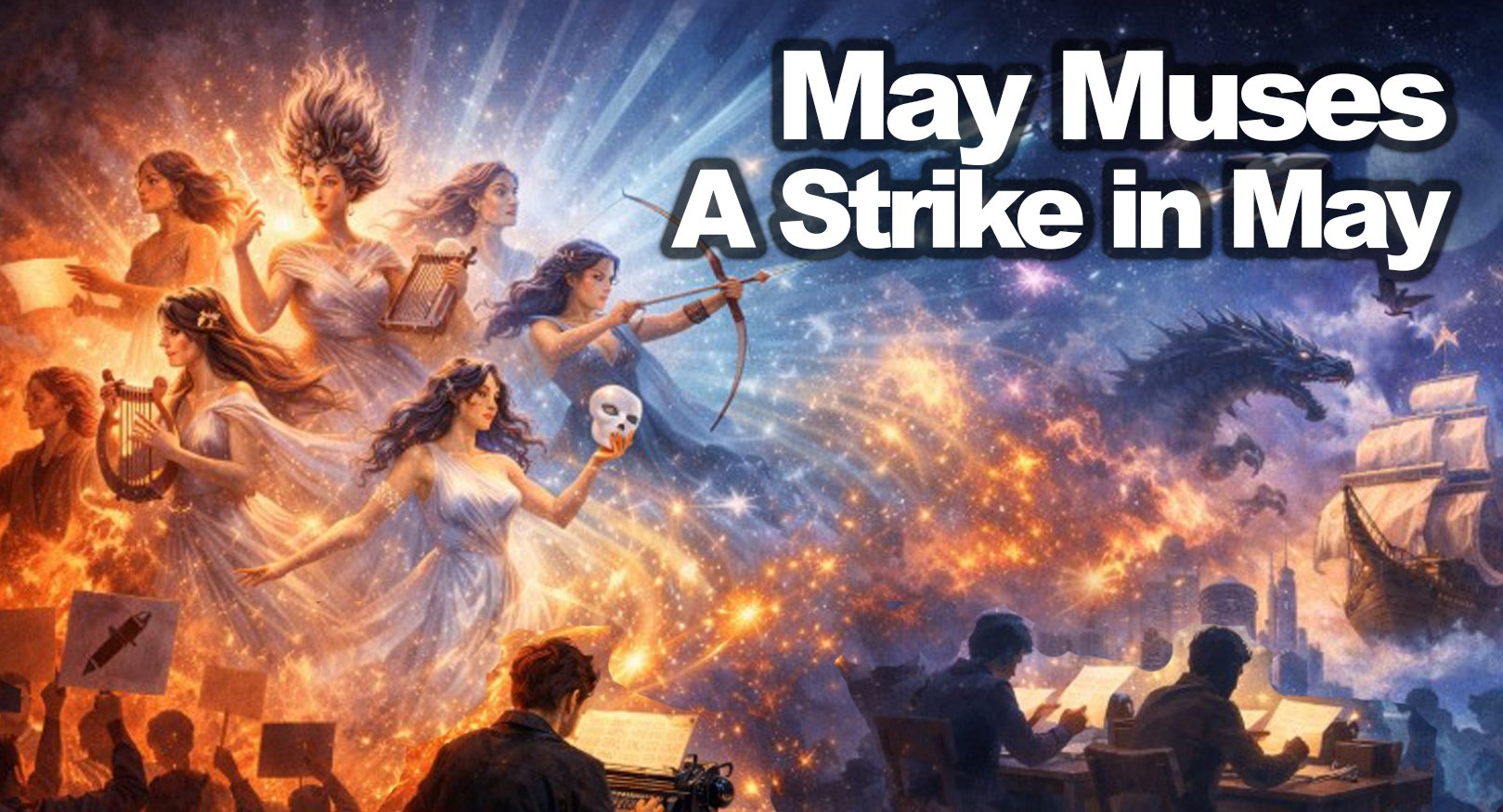
11. May Muses: A Strike in May
During a writers’ strike, nine mythic muses free themselves to inspire non-union creators, sparking a revolution of imagination that redefines creative freedom for all
PVD Fashion Looms Big
Weaving wonder without losing way
By AB Marcus
At 123 Dorrance Street on the 4th floor, A&C Fashions is a studio so small the iron steam fogs windows.
We see owners Allie and Cairn, two fresh RISD graduates of fashion hard at work. These two have talent, taste, and vision but the New England fashion scene always wants sameness. Their bold designs were treated like polite curiosities. Local New England buyers seemed to say: Not yet. Not like that.
And yes, they have two amazing dogs, Harley a 3-year-old French Bulldog and Maggie a 5-year-old Welsh Corgi, napping on fabric piles like they were clouds.
On one warm Summer day in July, Allie and Cairn took Harley and Maggie and drove to Newport, RI to see and breathe the salty air and take in the beauty of Narraganset Bay. While touring the Cliff Walk, they found and bought an old weaving loom at an estate sale near the Elms mansion.
The loom was made of ancient oak, iron gears with carved symbols of a four leaf clover, and a horseshoe on the top.
But when they wove on it back at their little Dorrance Street fashion shop, somehow the fabric patterns formed on their own like visions of possible futures.
Runways.
Applause.
Recognition.
But also darker paths: burnout, imitation, success without joy. The loom didn’t reveal fate it seemed to revealed choices.
Then suddenly and strangely, their pups soon got involved. Harley sometimes nudged Cairn when a pattern felt wrong. Maggie often pawed at Allie’s hand when the design strayed from their heart. Incredibly in some mysterious way their two dogs kept them grounded, reminding them what success was for.
Soon, major fashion houses came with offers.
Wealth.
Fame...
But they refused.
Instead, they continued to weave meaning into their classy colorful couture coats lined with poetry, scarves patterned like the Providence River, astounding new sleek dresses curvy like the Pawtucket S curves. Colorful, dynamic clothing people didn’t just wear but they felt.
And slowly, the city and New England changed its mind. Then New York. Then Paris.
But the real victory wasn’t fame.
It was that they rose without unraveling who they were.
Backstage at their first international Paris show, their little furry friends Harley and Maggie sat proudly with their tiny matching A&C Fashion bandanas.
“We chose the right pattern,” Cairn said.
“No,” Allie smiled.
“We wove it.”
The End
2-Min Narrated Story
PVD Fashion Looms Big
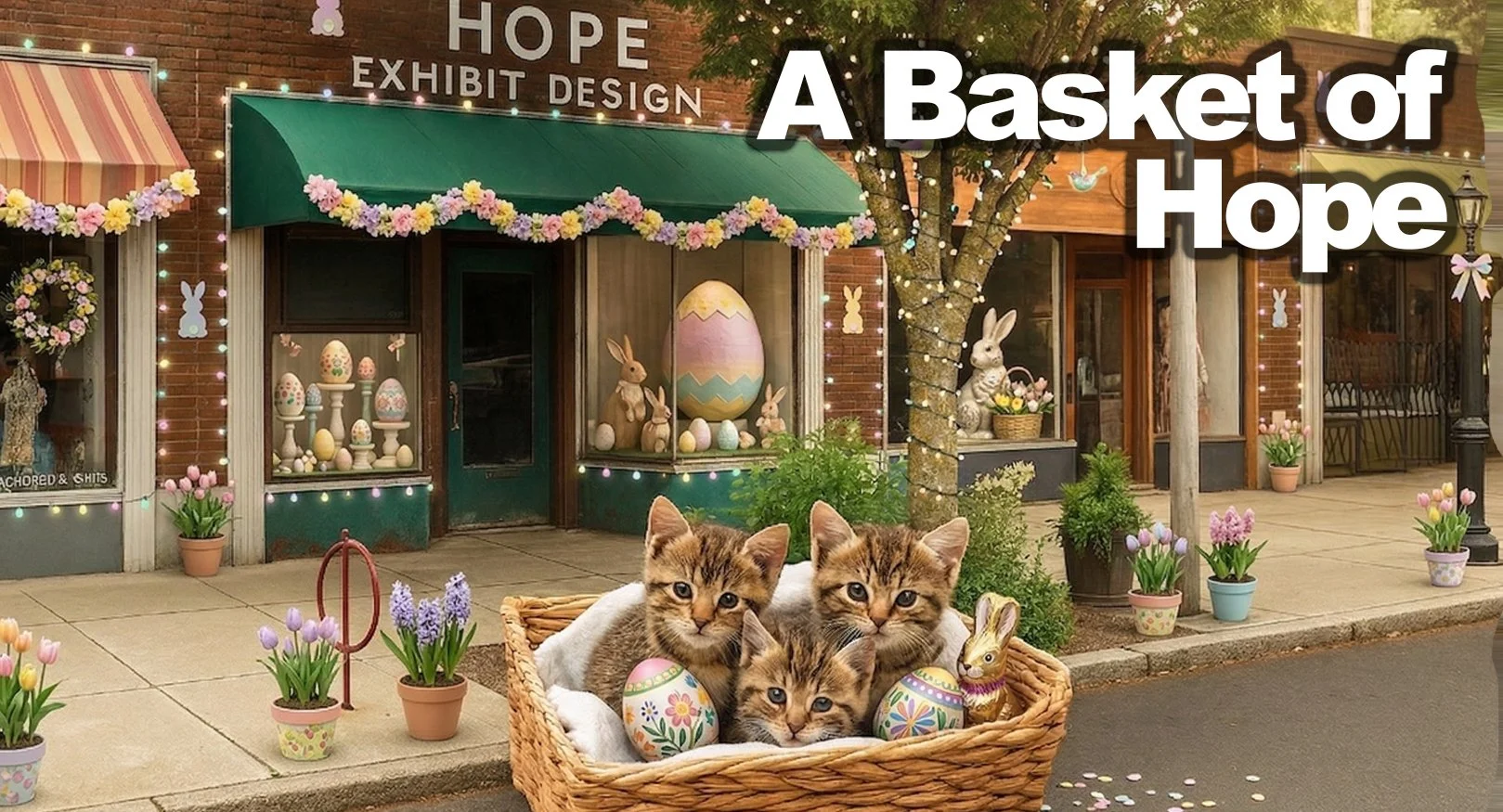
A Basket of Hope
RISD Museum redesign & kittens
By AB Marcus
On a crisp November morning in Providence, Rhode Island at 806 Hope Street, Esther and Daura unlocked the door to their tiny storefront studio "Hope Exhibit Design," expecting another long day of drawing, drafting, and displays - the kind of work that kept them going even when everything else felt tight.
But today, a woven basket waited on the welcome mat at the front door. Inside, three tabby kittens Rocky, Kona, and Leo blinked up with newborn innocence. A handwritten note lay across the blanket:
“I know you will take good care of Rocky, Kona, and Leo! God Bless You!”
Esther exhaled sharply. They were barely holding their business together as it was.
Competing against massive New York exhibit firm Tessellate Exhibit & Experience Design for the RISD Museum redesign contract felt like climbing a mountain in socks...
And kittens were not part of the plan.
Daura scooped them up gently. “Maybe they’re meant to be here,” she said.
By noon, an email arrived from 20 North Main Street, Providence - The RISD Museum.
The subject line read: "Final Round: 24-hour design challenge deadline."
So these two PVD display designers had just a single day to produce something remarkable while famous New York Exhibit giant Tessellate had big budgets, full teams, software specialists, and entire floors dedicated to proposals with interactive digital technologies like AR and VR.
"How can we compete with them?" Esther said.
All afternoon and deep into the night, the two worked at a feverish pace.
While their competitors released flashy teasers online - multi-million-dollar renderings dripping with polish.
Esther felt the weight of society’s expectations pressing in: "big cities win, small studios lose," she said nervously.
"Maybe Providence wasn’t meant to topple Manhattan," Daura said.
Around 2 a.m., Rocky the little climber kitten, knocked over a dusty stack of archived museum display books they kept for inspiration.
Just then a museum curator’s note slipped free:
“Exhibits should feel like home where discovery feels personal, human, and hopeful.”
Esther held the paper like a compass. “This. This is what we’re missing.”
The mood shifted. They redesigned not with intimidation, but with Providence’s quiet brilliance creativity at human scale.
A week later, RISD called.
Hope Exhibits WON!!!
Somehow, Providence's little "Hope Exhibit Design" had defeated the Big Apple Firm!
When RISD museum director, Tsugumi Maki visited their studio, the three curious kittens curled atop the winning model like tiny guardians.
Which made her laugh! "We all loved your hopeful human design!" she said.
Just then, Esther looked at the handwritten note pinned above her desk to take good care of the kittens with the message... "God Bless You!"
She realized hope comes softly, on a cue only when the heart can hear it.
And sometimes, it comes in a basket on Hope Street.
The End.
Narrated Story - 2 Min:
'REAL WORLD' Design
on Weybosset Street
'REAL WORLD' Design
on Weybosset Street
Every campaign AI produced felt hollow...
By AB Marcus
In the Creative Capital, even the traffic lights whisper in wavelengths of wonder.
Tony, Josie, and Jeff ran their small advertising agency from a brick building at the curve of Weybosset Street in downcity Providence where the walls were covered with ideas ~ half-sketched slogans, mood boards, and fragments of dreams.
Buddy, their golden-haired retriever and unofficial art director, slept beside the printer, which he distrusted less than the AI that now wrote half their headlines.
At first, the new “creative intelligence” had seemed miraculous. It generated concepts faster than coffee could cool. But soon, the trio began to notice something uncanny ~ every campaign it produced felt strangely hollow, as if the soul had been vacuum-sealed out of the work.
Just then the trio decided to stop relying on the AI algorithm. Instead, they began walking Providence streets and neighborhoods IRL, sketching signs, overhearing laughter outside AS220, photographing murals that bloomed on city walls. like secret, prayers. They rediscovered color through imperfection ~ the crack in a tile, the way rain altered a poster’s ink.
By afternoon a thunder storm burst sent them running back to their office. Lightning hit a transformer near the river, plunging downcity into desolate darkness. Buddy barked - sharply - as the computers powered down for good. Josie lit candles.
Finally, the rain and thunder stopped and there was a sudden quiet in their little design office. Now, they finally had time to think.
By dawn, Weybosset Street was awake again with chiming rebooted office computers and equipment. So they gathered the remains of their failed AI creative campaigns, and tossed them in the shredder.
They decided to launch a new kind of ad campaign - one not for products, but for possibilities.
And their tagline was handwritten, not typed. on a big poster in their front window that read:
“Creativity turns questions into blueprints.”
The next day, people stopped in front of their window to stare. Some smiled. One left a note: Thank you for remembering the human part.
Buddy wagged his tail and twirled in a left handed circle before dropping down for his afternoon nap. Providence glowed.
"Let's begin again, let's start fresh designs with enthusiasm and clever courageous creativity "In Real Life" from now on! " Jeff said.
"And real world Creativity will always be the bridge between wondering and building," Josie said.
The End.
A New Game
1:49 Sec ~ Narrated Story
Design Adventure Stories ~ Providence RI
A New Game
What Happened The Day They Left
By AB Marcus
The day the news broke, the air in Providence and Pawtucket and all over Rhode Island ... felt hollow.
The big toy company packed its boxes, dimmed the lights for the last time, and left for Boston.
For decades, Rhode Island’s heartbeat had been the rhythm of dice rattling, plastic pieces snapping into place, ideas tumbling like marbles across drawing boards.
Catherine watched from the sidewalk with a clenched jaw. Beside her, Robert muttered, “They never listened.
Every pitch I made ...dismissed. Like imagination had to pass through a corporate filter first.” Ashley folded her arms, eyes shining. “Well, maybe that corporate filter just left town.”
Freddy chuckled. “Then it’s our turn to play.”
That night, they gathered in an empty mill building - red brick, creaky beams, the scent of sawdust lingering from its former life in the old Providence Jewelry District where Eddy and Point Street meet.
On the table lay a single sheet of paper with two words scrawled in marker: A New Game.
Ideas poured like spilled Legos: clever puzzles, cooperative games for families, new twists on classics. Games that taught kindness, sparked laughter, and turned boredom into brilliance. For once, nobody said no. Every voice mattered.
Funding, though ... that was the big question. But this time Rhode Island was listening. Two Local investors stepped up, Jonathan & Joseph were proud to see creativity stay home, offered seed money. Suddenly a spark became a flame like a WaterFire Brazier at full lighting.
“What do we call it?” Catherine asked, pen hovering. Robert grinned. “Kidovo. Kids evolve. Ideas evolve.” Ashley tilted her head. “Or maybe USA Toys - proud and bold.” Freddy laughed. “Either way, it starts right here.”
And so a new company was born. Whether it was called KIDOVO or USA Toys mattered less than the truth beneath it: that the power of play belonged not to the corporation that left, but to the community that stayed.
When one game ends, another begins. And the truest design is not made in leaving, but in staying ~ to play again, together.
The End.
All Stories Rated G - All Ages!